London Business Partnership
Redesigning a non-profit's digital presence to reach London's underserved SMEs.
Redesigning a non-profit's digital presence to reach London's underserved SMEs.
A self-initiated project inspired by my internship at London Business Partnership. This project covers the UX/UI of a corporate website promoting the companies services.
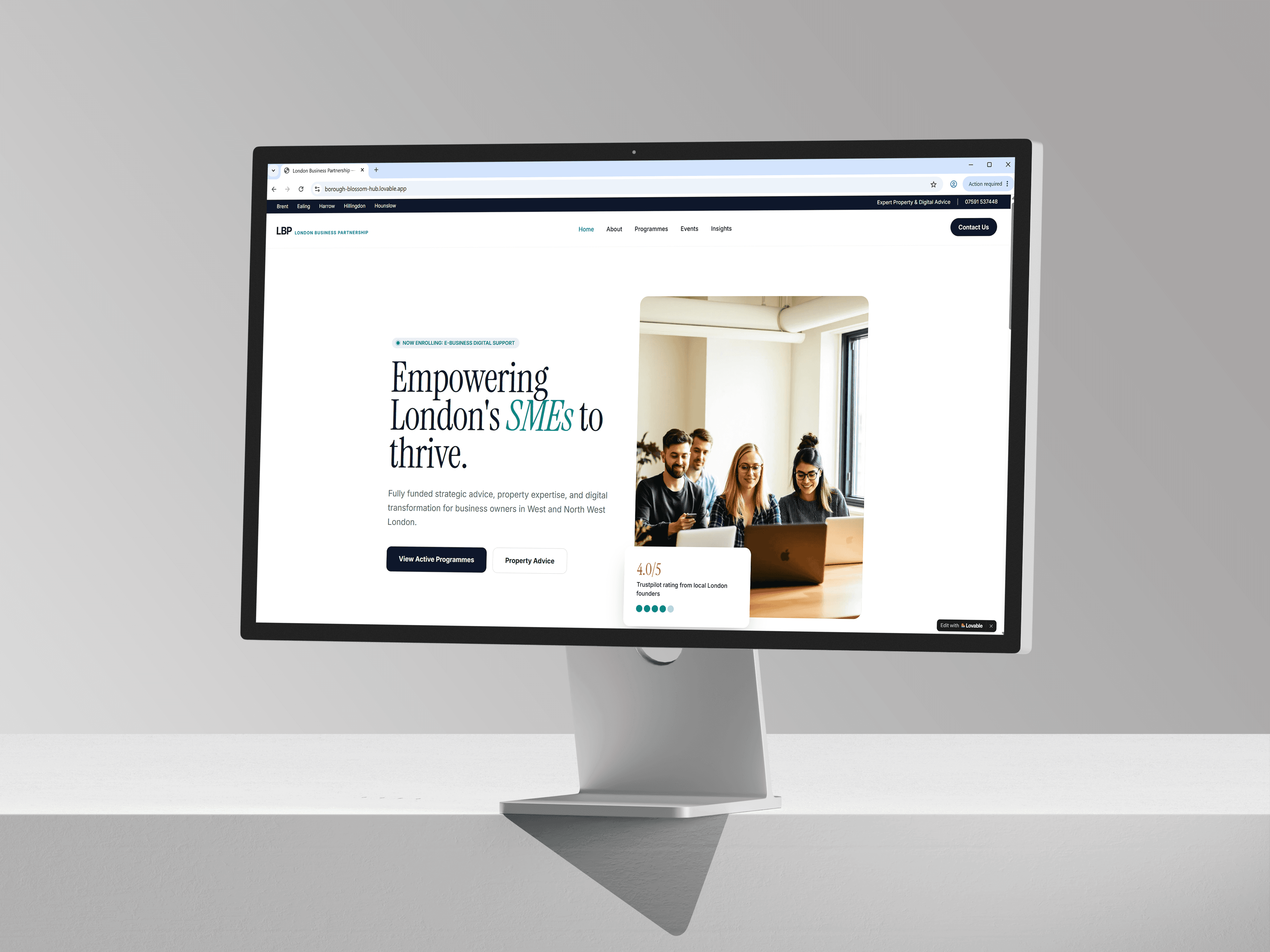
London Business Partnership (LBP) empowers small businesses across targeted London boroughs through funded programmes, property advice, and digital support. This project involved designing a concept website to better connect LBP with the entrepreneurs who need them most.
Tools Used
Figma

Lovable

Miro
Miro
Sector
Non-profit / SME Support
Non-profit / SME Support
Non-profit / SME Support
Area of focus
UX/UI Design
Web Design
UX/UI Design
Web Design
Timeline
2026
2026
2026
Skills
Site Mapping
Site Mapping
Site Mapping
Wireframing
Wireframing
Wireframing
Prototyping
Prototyping
Prototyping
Figma
Figma
Figma
Lovable AI
Lovable AI
Lovable AI
UX research
UX research
UX research
Accessibility
Accessibility
Accessibility
Who is LBP?
Who is LBP?
Founded in 2012, London Business Partnership is an award-winning non-profit serving SMEs across Brent, Ealing, Harrow, Hillingdon, and Hounslow. Backed by the UK Shared Prosperity Fund and the Mayor of London, LBP offers business coaching, property advice, and digital support programmes to help entrepreneurs grow.
Founded in 2012, London Business Partnership is an award-winning non-profit serving SMEs across Brent, Ealing, Harrow, Hillingdon, and Hounslow. Backed by the UK Shared Prosperity Fund and the Mayor of London, LBP offers business coaching, property advice, and digital support programmes to help entrepreneurs grow.
The Problem
The Problem
LBP's existing web presence failed to clearly communicate its funded programmes to time-poor SME owners. With a hard target of 1,103 business sign-ups, the site needed to convert the right visitors, not just attract traffic from specific London boroughs.
LBP's existing web presence failed to clearly communicate its funded programmes to time-poor SME owners. With a hard target of 1,103 business sign-ups, the site needed to convert the right visitors, not just attract traffic from specific London boroughs.
Target users
Primary users are SME owners in West London boroughs seeking business or property support. Secondary audiences include women entrepreneurs and digitally underserved businesses. Borough councils and the Mayor of London form a tertiary credibility audience requiring evidence of impact.

Competitive landscape
LBP competes with generic business support portals and council-run schemes that lack personalised guidance. Unlike broader platforms, LBP's strength is its hyper-local, funded, expert-led model. The site needed to clearly differentiate this offer from free-at-point-of-use but impersonal government resources.
The solution
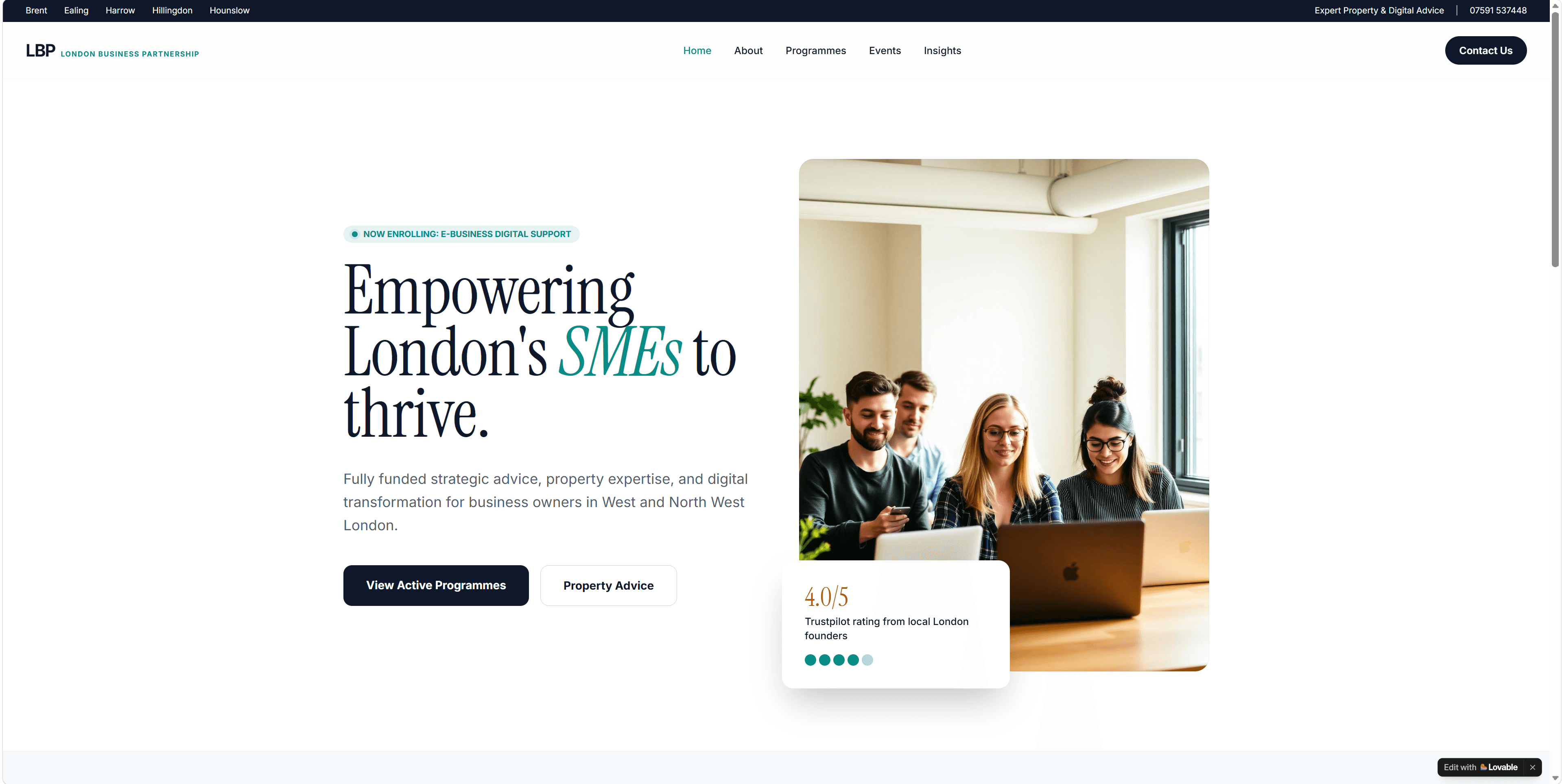
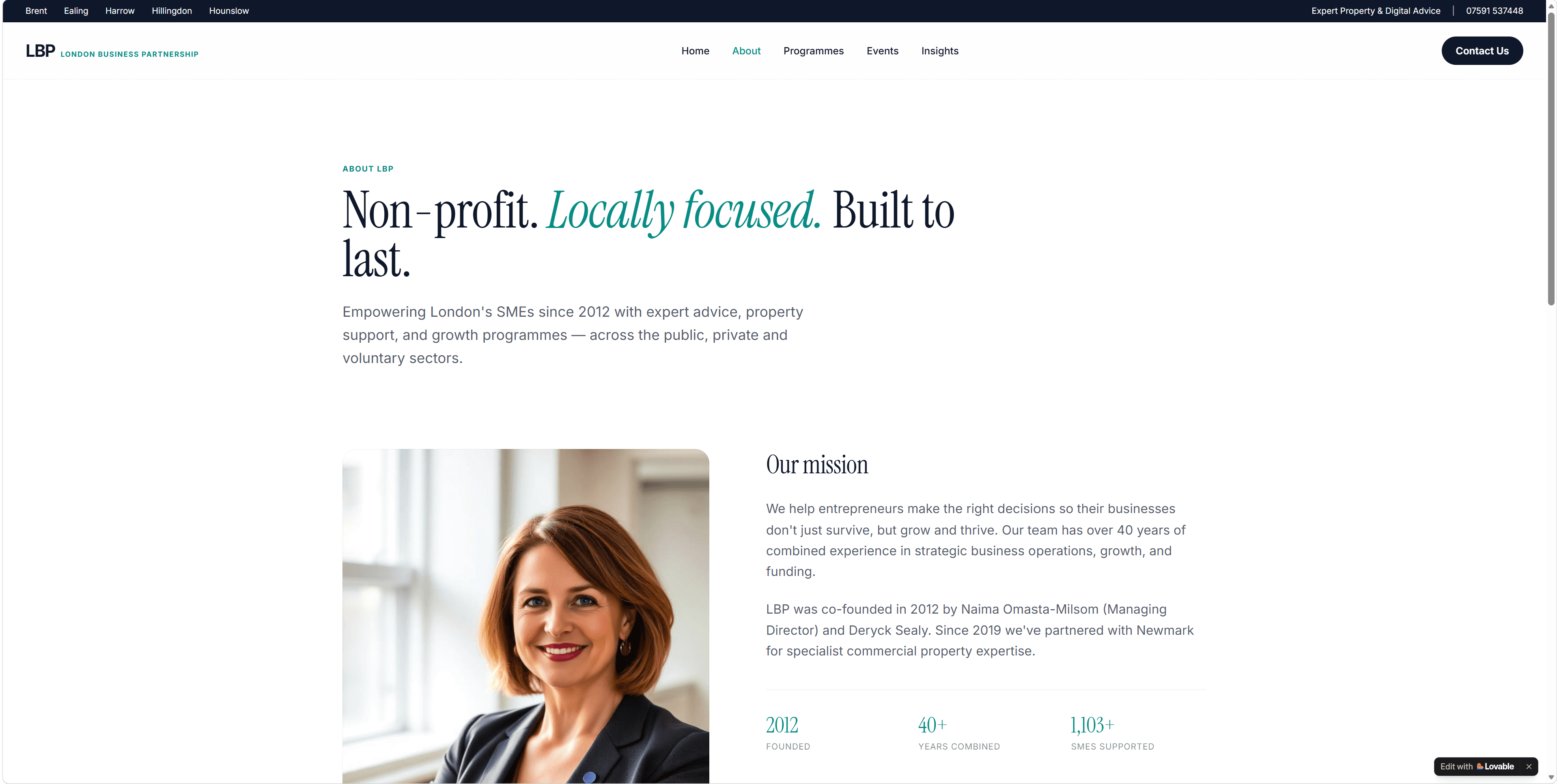
A redesigned concept website with clear programme pathways, borough-specific messaging, and prominent calls-to-action for sign-ups. Accessibility and mobile-first design were prioritised, given many SME owners browse on phones. Trustpilot integration and funder logos reinforced legitimacy for both entrepreneurs and funding partners.
Key metrics include programme enquiry form submissions, visitor-to-sign-up conversion rate, and percentage of sessions from target boroughs. Engagement is measured by time on programme pages, bounce rate, and pages per session. Operational health is tracked through mobile conversion rate, contact click-throughs, and broken link monitoring.
The Design Process
Mapped LBP's content into a clear hierarchy, organising programmes, services, and credibility content to guide user journeys toward sign-up.

Sketched low-fidelity layouts to establish page structure, navigation patterns, and the placement of key calls-to-action across core pages.

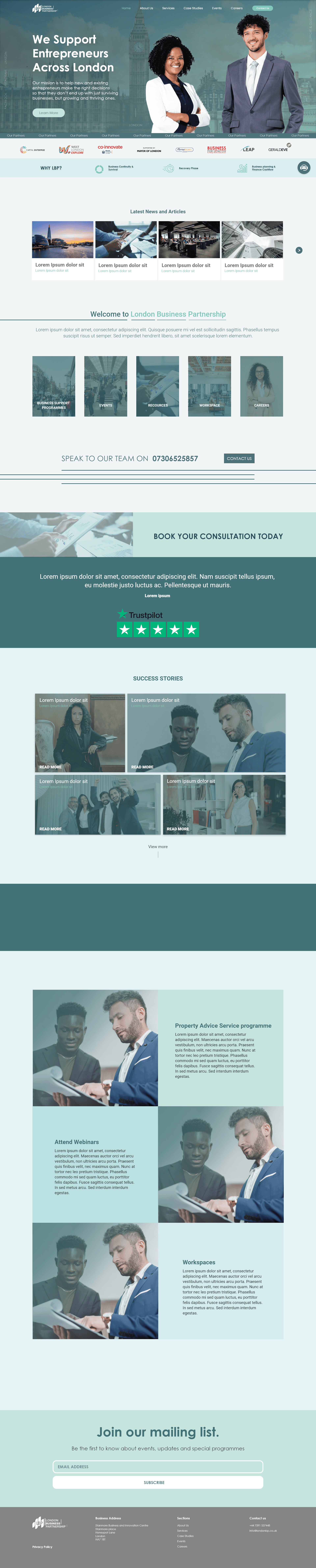
Designed medium fidelity screens in Figma, adding visual hierarchy, typography, and content to test the user flow before build.
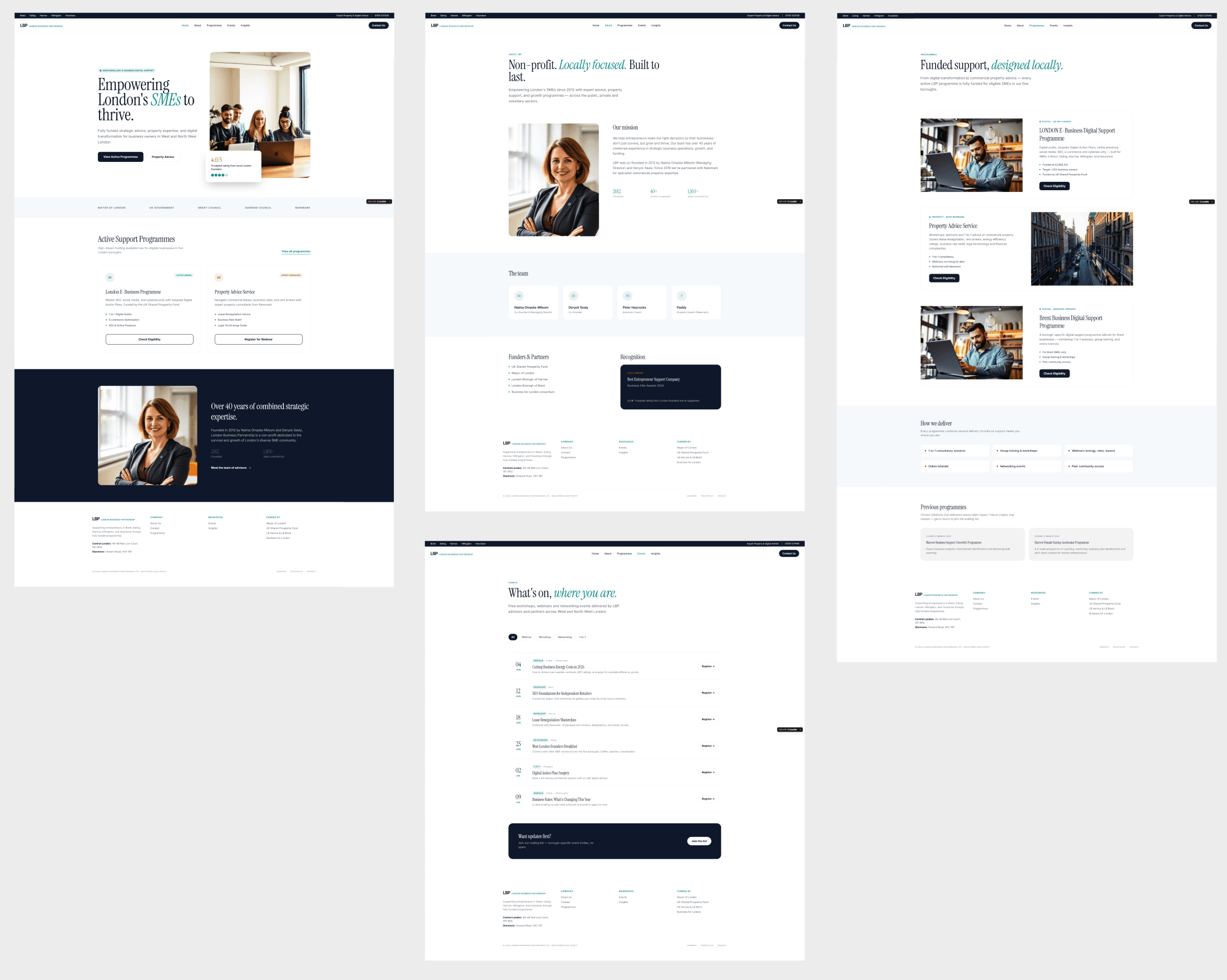
Used Lovable AI to generate the live concept website from the prototype, enabling a functional, designed output without manual front-end coding.
Reflections
This project highlighted how much a non-profit's website must work for multiple audiences simultaneously, funders, entrepreneurs, and partner organisations. Using Lovable AI accelerated the build phase significantly, though it required careful prompting to honour the UX decisions made earlier. The biggest insight was that clarity of offer not visual complexity, drives conversions for this audience. Future iterations would benefit from real user testing with SME owners from the target boroughs.
Haaris Ahmed
Copyright 2026 by Haaris Ahmed
Haaris Ahmed
Copyright 2026 by Haaris Ahmed
Haaris Ahmed
Copyright 2026 by Haaris Ahmed
Target users
Primary users are SME owners in West London boroughs seeking business or property support. Secondary audiences include women entrepreneurs and digitally underserved businesses. Funders — borough councils and the Mayor of London — form a tertiary credibility audience requiring evidence of impact.
Competitive landscape
Primary users are SME owners in West London boroughs seeking business or property support. Secondary audiences include women entrepreneurs and digitally underserved businesses. Funders — borough councils and the Mayor of London — form a tertiary credibility audience requiring evidence of impact.
The solution
A redesigned concept website with clear programme pathways, borough-specific messaging, and prominent calls-to-action for sign-ups. Accessibility and mobile-first design were prioritised, given many SME owners browse on phones. Trustpilot integration and funder logos reinforced legitimacy for both entrepreneurs and funding partners.
Key metrics include programme enquiry form submissions, visitor-to-sign-up conversion rate, and percentage of sessions from target boroughs. Engagement is measured by time on programme pages, bounce rate, and pages per session. Operational health is tracked through mobile conversion rate, contact click-throughs, and broken link monitoring.
The Design Process
Mapped LBP's content into a clear hierarchy, organising programmes, services, and credibility content to guide user journeys toward sign-up.
Sketched low-fidelity layouts to establish page structure, navigation patterns, and the placement of key calls-to-action across core pages.
Designed medium fidelity screens in Figma, adding visual hierarchy, typography, and content to test the user flow before build.
Used Lovable AI to generate the live concept website from the prototype, enabling a functional, designed output without manual front-end coding.