VYBE
Designing a Ride Hailing App For An Autonomous Taxi Service
Designing a Ride Hailing App For An Autonomous Taxi Service
A self initiated project as part of my university course. The project covers the UX/UI of a ride hailing app for autonomous taxis operating on London's streets.

As part of my university major project, I designed VYBE, a tailored and revolutionary ride-hailing service for fully autonomous vehicles within London. This project explored common transport and lifestyle issues that Londoners face, such as traffic congestion and journey planning.
Tools Used
Figma

Adobe Illustrator

Blender

Miro
Miro
Sector
Transport
Transport
Transport
Area of focus
UX/UI Design
Mobile Design
UX/UI Design
Mobile Design
Timeline
2024 - 2025
2024 - 2025
2024 - 2025
Skills
Wireframing
Wireframing
Wireframing
Interactive Prototyping
Interactive Prototyping
Interactive Prototyping
Iconography
Iconography
Iconography
Typography
Typography
Typography
layout
layout
layout
Branding
Branding
Branding
Hierarchy
Hierarchy
Hierarchy
User Flows
User Flows
User Flows
User Research & Testing
User Research & Testing
User Research & Testing
3D Design
3D Design
3D Design
3D Animation
3D Animation
3D Animation
What is the Service?
I wanted to design a different approach to ride-hailing by utilising autonomous vehicles and reimagining the traditional ride-hailing experience. The service I designed consists of two major components: a ride-hailing app/platform and a customisable autonomous vehicle. Users can plan their journeys using an AI-powered planner and personalise an immersive vehicle interior with a range of themes and experiences. Pick-up and drop-off locations are automatically calculated, allowing riders to simply arrive at the designated location. This creates a seamless, convenient, and user-centred ride-hailing experience.
I wanted to design a different approach to ride-hailing by utilising autonomous vehicles and reimagining the traditional ride-hailing experience. The service I designed consists of two major components: a ride-hailing app/platform and a customisable autonomous vehicle. Users can plan their journeys using an AI-powered planner and personalise an immersive vehicle interior with a range of themes and experiences. Pick-up and drop-off locations are automatically calculated, allowing riders to simply arrive at the designated location. This creates a seamless, convenient, and user-centred ride-hailing experience.
Project Planning
The aim of the project was to design the user interface and user experience of a digital platform for a driverless taxi service operating in London. The research findings and key design decisions contributed to the development of a useful and impactful driverless taxi service that promotes environmental, transportation, social, and economic benefits for London and its residents.

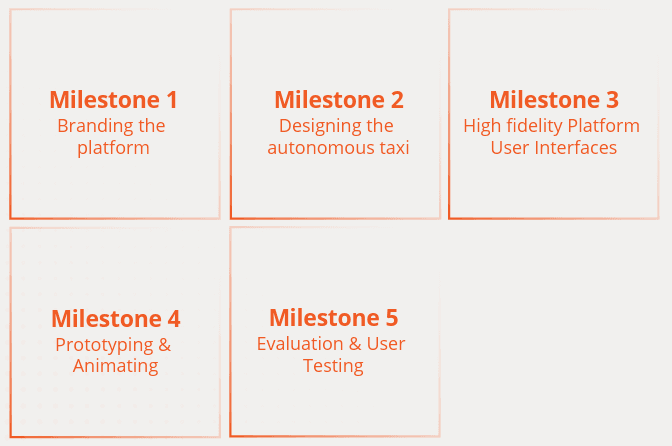
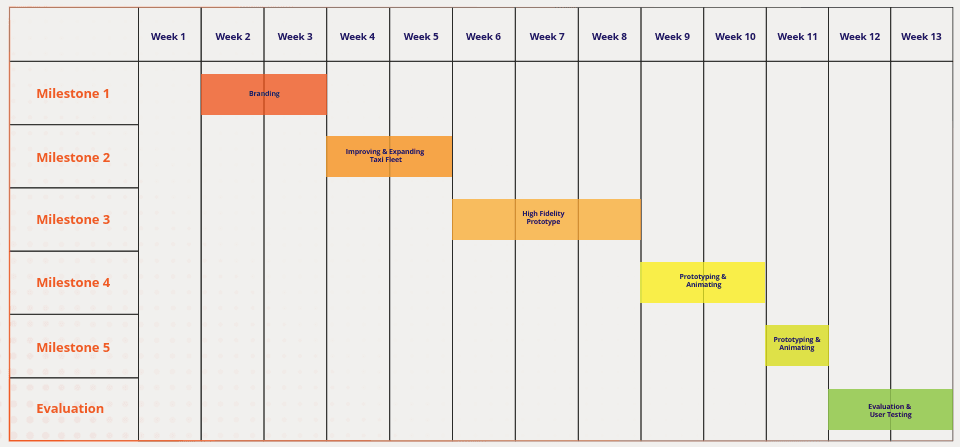
I created five key milestones, which were mapped out in a Gantt chart to help monitor the project timeline, manage progress, and prioritise tasks effectively.
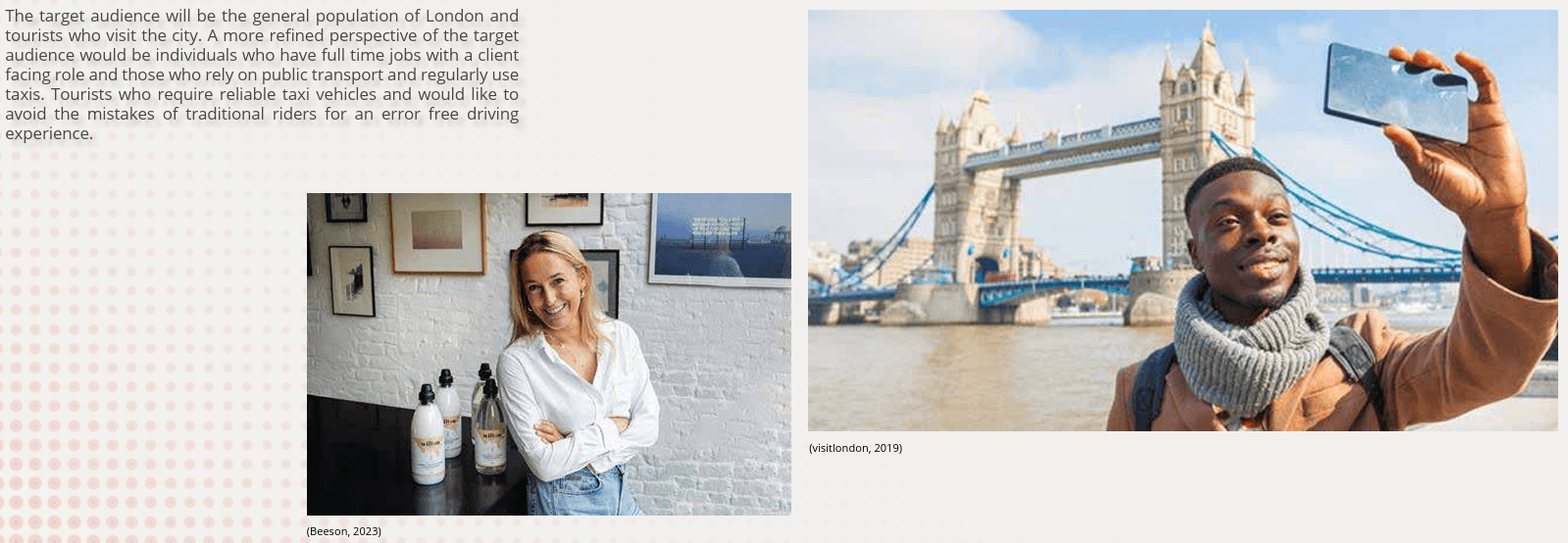
The target audience consisted of London residents and tourists visiting the city. More specifically, the service was aimed at individuals in full-time, client-facing roles, as well as those who regularly rely on public transport and taxi services for their daily travel. It also targeted tourists seeking a reliable and convenient transport option, helping them avoid common issues associated with traditional taxi services and providing a safer, more seamless travel experience.
Research & Insights?
The research was broken into 9 chapters:
The research was broken into 9 chapters:
What Are Autonomous Vehicles?
What Makes a Ride-Hailing Service?
Transportation in London
Competitors?
Case Studies & Examples
Market Trends
Technological Research
Branding Research
Attending an event for further insight - (I attended the 2024 London EV Show at London Excel Centre)
What Are Autonomous Vehicles?
What Makes a Ride-Hailing Service?
Transportation in London
Competitors?
Case Studies & Examples
Market Trends
Technological Research
Branding Research
Attending an event for further insight - (I attended the 2024 London EV Show at London Excel Centre)
Using A Design Methodology
The design methodology used for this project was the Iterative Design Spiral. This methodology begins with an initial project plan, followed by the definition of requirements. The next stage involves analysis and design, where ideas and solutions are explored and developed. The product is then implemented through prototyping and development. Once an initial version has been created, it progresses to the testing phase, where user feedback and performance insights are gathered. Following testing, the product is evaluated, and any findings can be fed back into earlier stages of the process for further refinement. The methodology typically progresses from low-fidelity concepts to high-fidelity solutions, allowing for continuous improvement through iteration.
I applied this process throughout the project to develop and refine my prototypes. Regular user testing was incorporated at key stages to gather feedback and inform design decisions, ensuring the final solution effectively met user needs and expectations.
The design methodology used for this project was the Iterative Design Spiral. This methodology begins with an initial project plan, followed by the definition of requirements. The next stage involves analysis and design, where ideas and solutions are explored and developed. The product is then implemented through prototyping and development. Once an initial version has been created, it progresses to the testing phase, where user feedback and performance insights are gathered. Following testing, the product is evaluated, and any findings can be fed back into earlier stages of the process for further refinement. The methodology typically progresses from low-fidelity concepts to high-fidelity solutions, allowing for continuous improvement through iteration.
I applied this process throughout the project to develop and refine my prototypes. Regular user testing was incorporated at key stages to gather feedback and inform design decisions, ensuring the final solution effectively met user needs and expectations.

The Initial Design Process
Initial Branding Work
The branding process began with a series of experimental sketches and logo explorations created in Adobe Illustrator. I explored a variety of typefaces, shapes, and symbols to capture the futuristic nature of an autonomous taxi service. Mood boards inspired by urban branding, technology, and transport systems informed my decisions regarding colour, typography, and visual style. Although the initial logo concepts lacked refinement, they provided valuable insights into the need for a bold and memorable visual identity. This process helped shape a brand that could stand out within London's transport landscape while remaining versatile across both digital and physical touchpoints.

Initial Autonomous Taxi Designs
The vehicle design process began with concept sketches and early 3D modelling experiments in Blender. Initial renders appeared overly boxy and did not align with user expectations of a modern, sleek mode of transport. Feedback from these early concepts highlighted the need for a more refined and visually appealing form, leading to the development of a streamlined silhouette. Vehicle blueprints were used to support accurate modelling and realistic proportions, while interior sketches explored the concept of a relaxing, lounge-like environment. This interior experience combined comfort with digital interactivity through integrated displays, ambient lighting, and customisable features designed to enhance the passenger journey.

Initial UX & UI Platform Designs
The user interface design process began with low-fidelity sketches and wireframes created in Figma for the ride-hailing application. Early site maps established the platform's structure, including key features such as journey booking, AI-powered trip planning, and vehicle customisation. Adobe Illustrator was used to develop and refine icons, along with other visual elements that contributed to the overall user experience. In parallel, in-vehicle interface concepts were explored to ensure a seamless connection between the mobile application and the autonomous vehicle. These screens focused on features such as entertainment, navigation, and journey information. Throughout the design process, the primary objective was to create a simple, intuitive, and accessible user experience that would be easy to use for a wide range of users.
The Final Design Process
Final Branding Work
The final branding outcomes were refined in Adobe Illustrator, resulting in a range of polished logo variations. Careful consideration was given to typography, spacing, and scalability to ensure the brand identity remained consistent across the mobile application, autonomous vehicle, and promotional materials. The final logo balanced a bold and innovative aesthetic with a sense of trust and accessibility, reflecting the core values of the service. The chosen colour palette conveyed energy, modernity, and forward-thinking design, helping the brand stand out within London's competitive mobility sector. Together, these elements created a cohesive and recognisable visual identity that unified the entire VYBE ecosystem.

Final Autonomous Taxi Designs
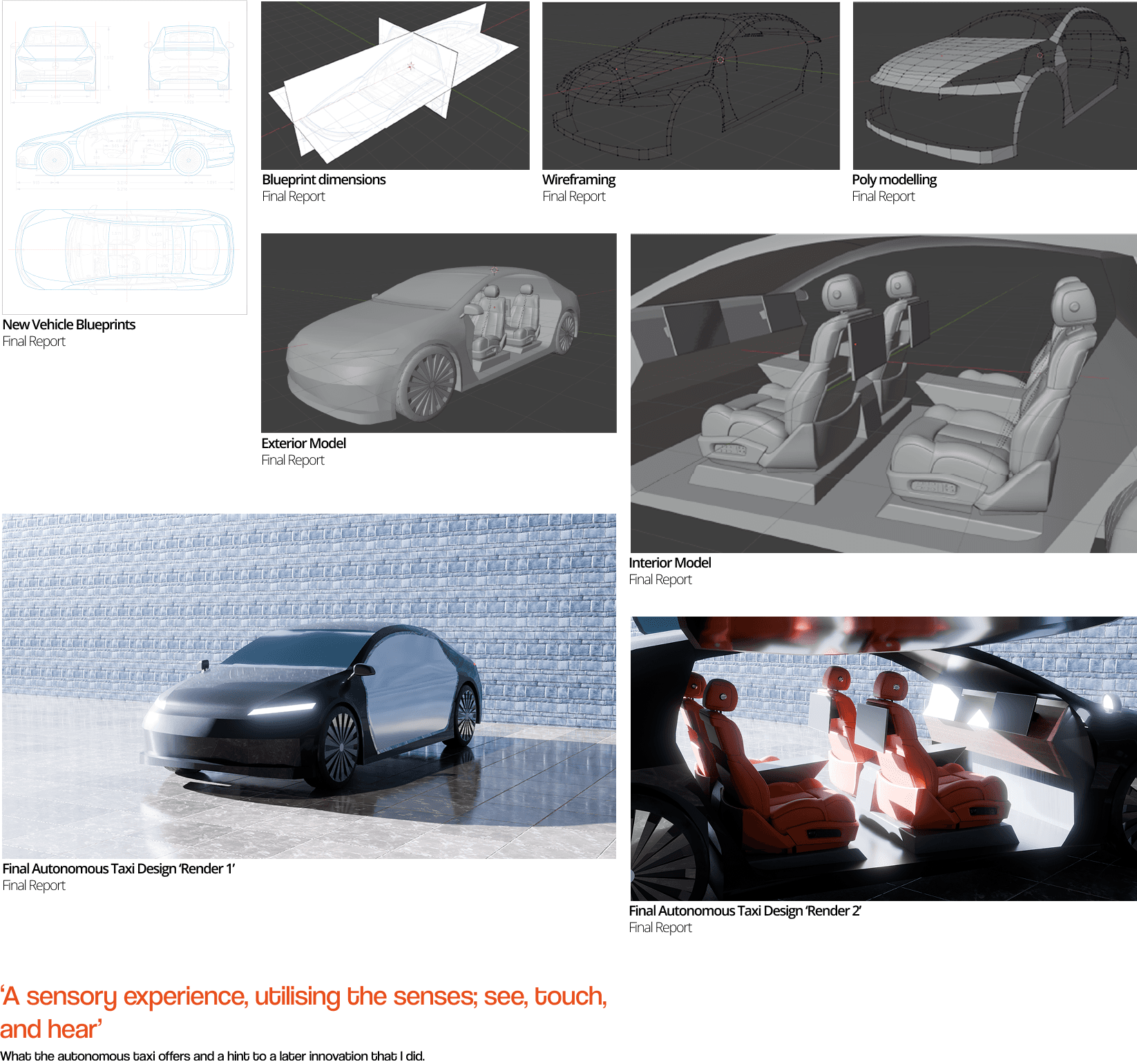
Using Blender, I developed a refined 3D model of the autonomous taxi, incorporating smoother curves and aerodynamic design features. The vehicle evolved from earlier boxy concepts into a sleek, futuristic form that was better suited to the expectations of modern urban transport and the streets of London. Interior modelling focused on creating an immersive passenger experience, with digital displays seamlessly integrated to support entertainment, navigation, and comfort. Various lighting and material textures were explored to establish a premium, lounge-like atmosphere within the vehicle. The final renders effectively showcased the taxi's dual purpose as both a mode of transport and an experiential environment, highlighting the innovative nature of the VYBE service.
Final UX & UI Platform Designs
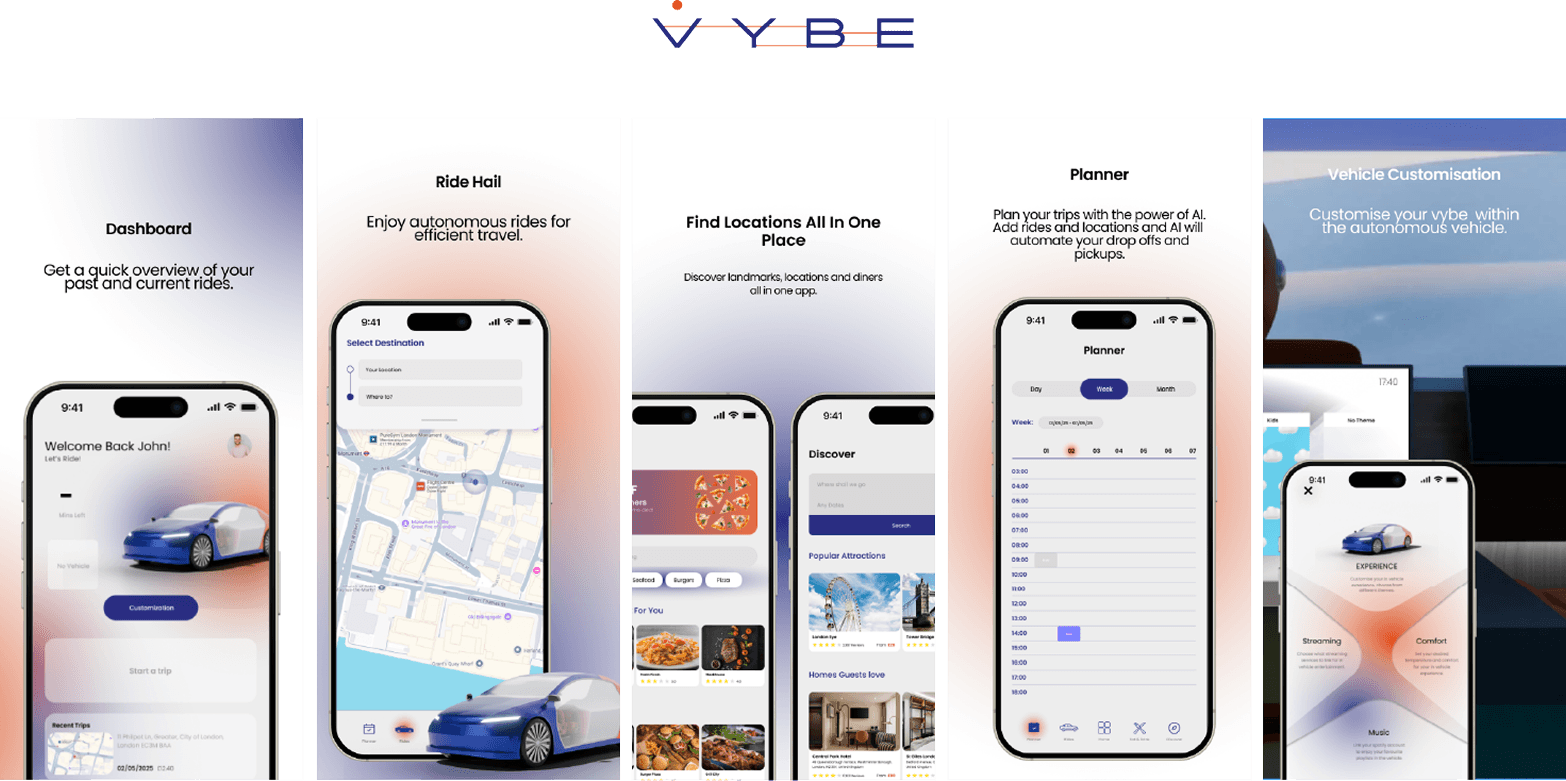
High-fidelity prototypes were produced in Figma, showcasing the booking system, AI planner, and personalisation options. Visual refinements applied design principles of clarity, consistency, and accessibility, while Adobe Illustrator was used for iconography. In-vehicle screen prototypes mirrored app functions, ensuring users experienced seamless continuity. Animations and immersive features were added. User testing with the SUS scale validated the platform, confirming strong usability and positive feedback on both simplicity and immersive design choices.

Technical Diagram/Back End
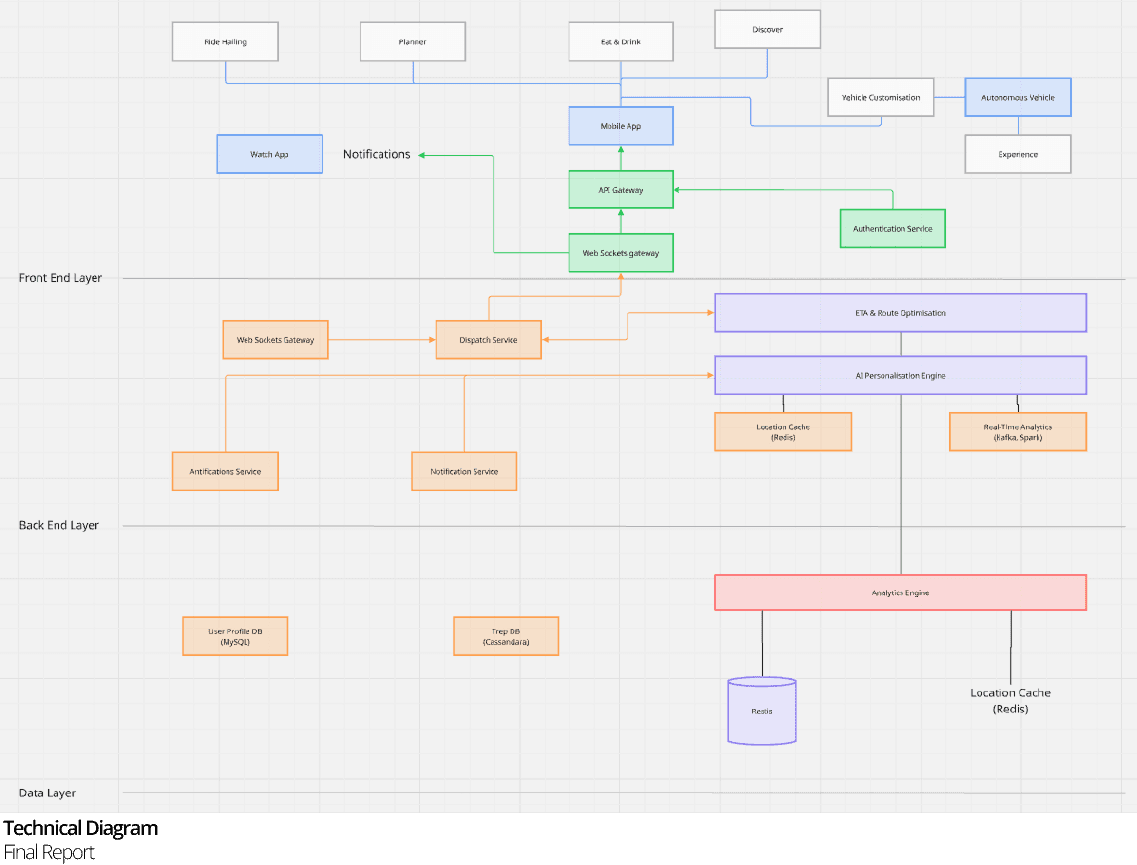
A technical diagram illustrated the ecosystem linking the mobile app, vehicle displays, and backend services. This architecture visualised how booking requests, navigation, and entertainment were synchronised across devices. Clear data pathways emphasised transparency and reliability, which are crucial for user trust. The design accounted for scalability, enabling future expansions such as wearable integration. This final system overview demonstrated how UX design, 3D modelling, and branding integrated into one cohesive, functional, and futuristic service.
The Outcome
I had used Figma to create a high-fidelity phone app and 3D modelled the autonomous taxi vehicle and its immersive interior. Using various tools in Figma, I achieved this minimal and simplistic look and feel that I desired to achieve. User testing was carried out, and most participants reported that the vehicle itself could have been improved, as the customisable immersion felt like it cut you off from the outside world, amongst other opinions.

Haaris Ahmed
Copyright 2026 by Haaris Ahmed
Haaris Ahmed
Copyright 2026 by Haaris Ahmed
Haaris Ahmed
Copyright 2026 by Haaris Ahmed
Project Planning
The aim of the project was to design the user interface and user experience of a digital platform for a driverless taxi service operating in London. The research findings and key design decisions contributed to the development of a useful and impactful driverless taxi service that promotes environmental, transportation, social, and economic benefits for London and its residents.
I created five key milestones, which were mapped out in a Gantt chart to help monitor the project timeline, manage progress, and prioritise tasks effectively.
The target audience consisted of London residents and tourists visiting the city. More specifically, the service was aimed at individuals in full-time, client-facing roles, as well as those who regularly rely on public transport and taxi services for their daily travel. It also targeted tourists seeking a reliable and convenient transport option, helping them avoid common issues associated with traditional taxi services and providing a safer, more seamless travel experience.
The Initial Design Process
Initial Brand Work
The branding process began with a series of experimental sketches and logo explorations created in Adobe Illustrator. I explored a variety of typefaces, shapes, and symbols to capture the futuristic nature of an autonomous taxi service. Mood boards inspired by urban branding, technology, and transport systems informed my decisions regarding colour, typography, and visual style. Although the initial logo concepts lacked refinement, they provided valuable insights into the need for a bold and memorable visual identity. This process helped shape a brand that could stand out within London's transport landscape while remaining versatile across both digital and physical touchpoints.
Initial Autonomous Taxi Designs
The vehicle design process began with concept sketches and early 3D modelling experiments in Blender. Initial renders appeared overly boxy and did not align with user expectations of a modern, sleek mode of transport. Feedback from these early concepts highlighted the need for a more refined and visually appealing form, leading to the development of a streamlined silhouette. Vehicle blueprints were used to support accurate modelling and realistic proportions, while interior sketches explored the concept of a relaxing, lounge-like environment. This interior experience combined comfort with digital interactivity through integrated displays, ambient lighting, and customisable features designed to enhance the passenger journey.
Initial UX & UI Platform Designs
The user interface design process began with low-fidelity sketches and wireframes created in Figma for the ride-hailing application. Early site maps established the platform's structure, including key features such as journey booking, AI-powered trip planning, and vehicle customisation. Adobe Illustrator was used to develop and refine icons, along with other visual elements that contributed to the overall user experience. In parallel, in-vehicle interface concepts were explored to ensure a seamless connection between the mobile application and the autonomous vehicle. These screens focused on features such as entertainment, navigation, and journey information. Throughout the design process, the primary objective was to create a simple, intuitive, and accessible user experience that would be easy to use for a wide range of users.
The Final Design Process
Final Brand Work
The final branding outcomes were refined in Adobe Illustrator, resulting in a range of polished logo variations. Careful consideration was given to typography, spacing, and scalability to ensure the brand identity remained consistent across the mobile application, autonomous vehicle, and promotional materials. The final logo balanced a bold and innovative aesthetic with a sense of trust and accessibility, reflecting the core values of the service. The chosen colour palette conveyed energy, modernity, and forward-thinking design, helping the brand stand out within London's competitive mobility sector. Together, these elements created a cohesive and recognisable visual identity that unified the entire VYBE ecosystem.
Final Autonomous Taxi Designs
Using Blender, I developed a refined 3D model of the autonomous taxi, incorporating smoother curves and aerodynamic design features. The vehicle evolved from earlier boxy concepts into a sleek, futuristic form that was better suited to the expectations of modern urban transport and the streets of London. Interior modelling focused on creating an immersive passenger experience, with digital displays seamlessly integrated to support entertainment, navigation, and comfort. Various lighting and material textures were explored to establish a premium, lounge-like atmosphere within the vehicle. The final renders effectively showcased the taxi's dual purpose as both a mode of transport and an experiential environment, highlighting the innovative nature of the VYBE service.
Final UX & UI Platform Designs
High-fidelity prototypes were produced in Figma, showcasing the booking system, AI planner, and personalisation options. Visual refinements applied design principles of clarity, consistency, and accessibility, while Adobe Illustrator was used for iconography. In-vehicle screen prototypes mirrored app functions, ensuring users experienced seamless continuity. Animations and immersive features were added. User testing with the SUS scale validated the platform, confirming strong usability and positive feedback on both simplicity and immersive design choices.
Technical Diagram/Back End
A technical diagram illustrated the ecosystem linking the mobile app, vehicle displays, and backend services. This architecture visualised how booking requests, navigation, and entertainment were synchronised across devices. Clear data pathways emphasised transparency and reliability, which are crucial for user trust. The design accounted for scalability, enabling future expansions such as wearable integration. This final system overview demonstrated how UX design, 3D modelling, and branding integrated into one cohesive, functional, and futuristic service.
The Outcome
I had used Figma to create a high-fidelity phone app and 3D modelled the autonomous taxi vehicle and its immersive interior. Using various tools in Figma, I achieved this minimal and simplistic look and feel that I desired to achieve. User testing was carried out, and most participants reported that the vehicle itself could have been improved, as the customisable immersion felt like it cut you off from the outside world, amongst other opinions.